
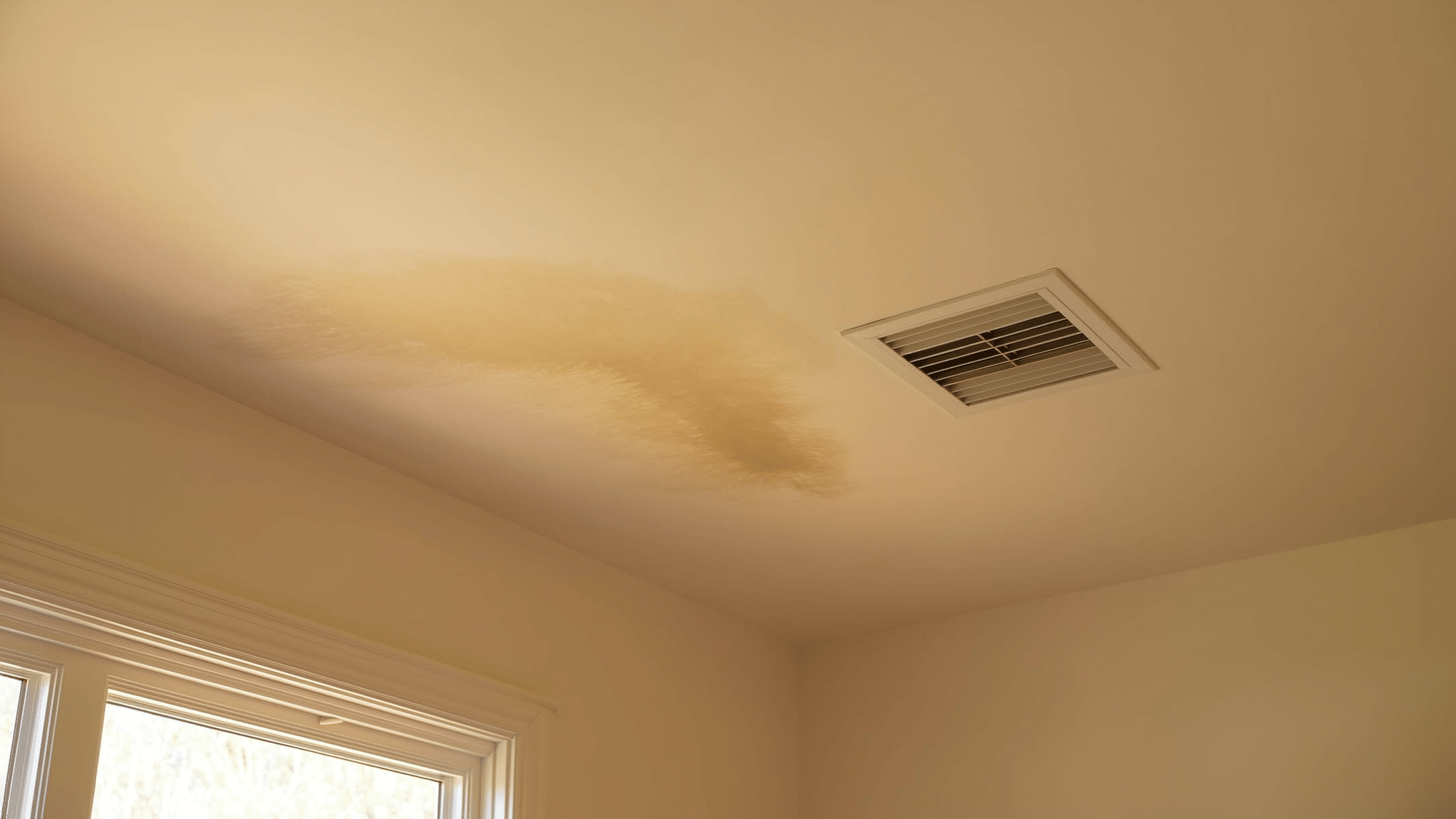
You looked up this morning and noticed it — a bubble in the ceiling paint, or a soft ring near the AC vent that wasn’t there last month. That’s not cosmetic. That’s your ceiling telling you water got in.
June is when SWFL homes start revealing what winter and spring quietly built up. Sarasota averages nearly six inches of rain in June across roughly 13 rain days, and summer humidity runs 65–75% all season. That combination puts three specific repair triggers into play at once.
The #1 culprit: your AC condensate drain
Florida AC systems pull 5–20 gallons of moisture out of the air every single summer day. That water exits through a condensate drain line — a small PVC pipe running from your air handler to a floor drain or outside. In about 70% of SWFL homes, the air handler sits in the attic.
When the drain line clogs, the overflow pan fills and spills. The water lands on attic insulation first, then soaks through to the ceiling drywall below.
The clog itself is almost always algae biofilm, not debris. Florida’s warm, humid drain line interiors are perfect for algae growth, and it can block a line in a single season. Clogged condensate drains account for roughly 29% of all Florida water damage insurance claims — making this the single most common source of interior ceiling damage in the state.
Clearing the drain line is your AC technician’s job. What HANDYS handles is what comes next: the damaged drywall.
What to look for
- Bubbled or blistered ceiling paint near a supply vent or light fixture
- Soft or spongy drywall when you press it gently with a finger
- A brown water ring that has dried but the center still feels slightly soft
- Discoloration that appeared after a stretch of humid or rainy weather
If the drywall is soft, it has to come out. Patching over wet or moisture-compromised drywall traps moisture inside the assembly and risks mold growth behind the repair. The damaged section gets cut back to solid material, new drywall is fitted and fastened, three coats of joint compound are applied and sanded, then primer and paint-matched finish coat.
That sequence takes 2–2.5 hours of skilled labor for a typical 4–6 square foot ceiling patch. It is not a one-afternoon DIY project if you want it to hold.
The second trigger: afternoon thunderstorm intrusion
Sarasota and Bradenton get intense, localized afternoon thunderstorms from June through September. The fast-moving storms drive rain sideways into roof flashing, window headers, and second-floor wall assemblies in ways that steady rain does not.
If you have an older home in South Sarasota, Palmer Ranch, or anywhere with original 1980s or 1990s windows, the flashing seals around those frames have had 30–40 summers of UV and thermal expansion. A hard storm event can push water past a seal that looked fine in dry season.
The resulting damage shows up as a vertical streak on interior drywall near a window corner, or discoloration on the ceiling directly below a roof penetration — a vent stack, a skylight, or a chimney chase.
The third trigger: slow flashing leaks that built up over winter
Roof flashing failures do not always announce themselves with a visible ceiling stain. Some work slowly — a tiny gap at a pipe boot or ridge cap seep — and accumulate moisture in the attic insulation for months before enough saturation reaches the drywall face to show up.
Homeowners in Gulf Gate, Englewood, or anywhere with tile roofs should pay particular attention here. Tile protects the structure but the underlayment and flashing beneath it ages. A slow leak will work through that underlayment for a long time before it becomes visible from inside.
What the repair actually costs
HANDYS charges $75–$125 per hour for skilled labor. Here is what installed repairs — materials and labor combined — typically run:
| Damage size | Installed cost |
|---|---|
| Small patch (1–2 sq ft) | $120–$180 |
| Ceiling patch after AC overflow (2–4 sq ft) | $150–$230 |
| Medium patch (4–6 sq ft) | $190–$260 |
| Large patch (8+ sq ft) | $260–$335 |
For context on what you would spend if you tried it yourself: a 4×8 sheet of drywall runs around $17–$22, joint compound about $23, mesh tape $8–$12, and primer $18–$30. The materials cost is real but manageable. The gap is in the execution — cutting a ceiling patch cleanly, floating three coats so the seam disappears under paint, and matching the sheen of a ten-year-old ceiling. That is the part that makes DIY attempts visible from across the room.
Why one visit usually closes it
HANDYS carries patch material, compound, and primer on the truck. For a standard AC-overflow ceiling patch, one visit handles the cut-out, the new drywall, the tape and compound work, and the primer coat. A second short visit applies the finish coat once compound cures — 24–48 hours later in summer humidity. Some homeowners schedule the paint match and finish coat for the same week.
The repair does not require permits. It does not require a licensed contractor. It is squarely within Florida handyman scope-of-work guidelines, and HANDYS technicians are background-checked, insured, and experienced with exactly this kind of summer repair.
The right order of operations
- If you suspect an AC condensate drain overflow: call your HVAC technician first to clear the line and confirm the source is resolved.
- Let the area dry — a dehumidifier in the room for 24–48 hours helps.
- Call HANDYS for the drywall repair once the moisture source is confirmed fixed.
Do not skip step one. Patching over an active leak, even a slow one, wastes the repair.
Get a free quote
If you are looking at a ceiling bubble, a soft spot, or a water ring anywhere in Sarasota, Bradenton, Lakewood Ranch, or the surrounding area, HANDYS can give you a free quote within 24 hours. Call 941-207-6969 or visit handys.now.
We will send a tech, look at it, and give you a straight number. No pressure to book on the spot.
